
A sliding door installation isn’t a single job, but a series of crucial stages: prepping the opening, setting the frame and track, hanging the panels, and then fine-tuning everything. From my experience, the most critical part by a long shot is the prep work. If you can ensure the opening is plumb, level, and square from the get-go, you’re setting yourself up for a smooth, weatherproof result. Get this right, and the rest of the project will feel like it’s clicking into place.
Preparing for a Perfect Installation
Success with any sliding door installation really boils down to what you do before you even think about lifting the door. Any seasoned professional will tell you that meticulous preparation is what stops frustrating problems from cropping up later. Think of this foundational stage as being all about precision and double-checking every last detail.
The very first thing you should do—and this is non-negotiable—is inspect your new door the moment it’s delivered. Check it over for any damage that might have happened in transit, like scratches on the glass or dings in the frame. Unpack all the components and lay them out, cross-referencing them with the parts list to make sure nothing’s missing. It’s so much better to sort this out now rather than when you’re halfway through the job.
Accurate Measurements Are Everything
Your entire project hinges on an accurately measured opening. Don’t just measure once. Take at least three width measurements—one at the top, one in the middle, and one at the bottom. Do the same for the height, measuring the left, centre, and right. Always work with the smallest of each set of measurements; this is your true working dimension.
A step people often forget is checking for “square.” You can use a large builder’s square for this, or if you don’t have one, the 3-4-5 method will confirm if the corners are true 90-degree angles. A good spirit level is absolutely essential here to ensure the sill is perfectly level and the side jambs are plumb (that is, perfectly vertical).
Pro Tip: If your opening isn’t perfectly plumb, level, or square, now is the time to fix it. Use packers and shims to correct minor imperfections before the frame goes in. If you skip this, you’re almost guaranteed a door that sticks, jams, or fails to create a proper weather seal.
Gathering Your Tools and Materials
Having all your tools and materials ready to go is the difference between a smooth job and a frustrating one full of delays. Before you start, it’s wise to gather everything you’ll need.
Your choice of materials is also incredibly important, especially with the variety of doors available in the UK. In 2023, the UK doors market was valued at around £4.7 billion. Patio doors, which include sliding systems, made up about 35% of that—a huge £1.65 billion sector. While homeowners are increasingly choosing premium aluminium frames, uPVC still holds the lion’s share, accounting for 62% of patio door installations. You can discover more about these UK door market trends and see how material choices affect performance.
This variety means you absolutely must match your sealant and fixings to your door’s material (whether it’s uPVC, aluminium, or timber) and your wall’s construction (brick, block, or a timber frame). Using the wrong products can seriously compromise the weatherproofing and structural integrity of the installation.
To make sure you’re prepared, here’s a quick rundown of the essentials.
Your Sliding Door Installation Toolkit
Gather these essential tools and materials to achieve a professional-quality installation from the start.
| Tool/Material | Purpose | Pro Tip |
|---|---|---|
| Spirit Level | Checking the frame is plumb and level. | A longer level (1200mm or more) gives a more accurate reading across the frame. |
| Tape Measure | For all dimensional checks. | A quality locking tape measure is a must. Double-check every measurement. |
| Drill | Driving fixings and pre-drilling holes. | Use a combi drill with hammer action for masonry and a good set of sharp drill bits. |
| Sealant Gun | Applying silicone sealant for weatherproofing. | A dripless gun gives you better control and a much neater finish. |
| Low-Modulus Silicone | Sealing the exterior frame against weather. | Low-modulus silicone allows for expansion and contraction without cracking. |
| Frame Fixings/Screws | Securing the door frame to the wall. | Always use fixings appropriate for your wall type (masonry, block, or timber). |
| Plastic Shims/Packers | For levelling and squaring the frame. | Get a mixed pack of different thicknesses. They’re invaluable for fine-tuning. |
| Builder’s Square | To check the opening and frame for square. | The 3-4-5 method works great if you don’t have a large square. |
Having these items on hand before you begin will save you from making frantic trips to the DIY shop and help ensure the job is done right the first time.
Setting the Frame and Track System
With your opening perfectly prepped, you’re ready to tackle the foundation of your new door: the frame and track system. I’ve seen enough installations to know this is where precision and patience really pay off. A well-set frame is the absolute key to a sliding door that’s smooth, weatherproof, and lasts for years to come.
The first move is to carefully place the new door frame into the prepared opening. Don’t be in a hurry to fix it in place just yet. The smart play is to ‘dry fit’ the frame first, looking for a consistent gap of around 10-15mm between the frame and the wall on all sides. This little bit of wiggle room is crucial for making adjustments and getting everything perfectly square.
Once you’re satisfied with the initial placement, it’s time to bring in the plastic packers, or shims, as they’re also known.
Getting the Frame Perfectly Level and Plumb
Always start with the bottom sill. Place packers directly underneath it, focusing on the corners and then at regular intervals across the length. Add or remove them until your spirit level gives you the thumbs-up – perfectly level. With the sill sorted, you can move on to the side jambs.
For the sides, you’ll want to use packers at the top, middle, and bottom of each jamb. Gently push them into the gap until the frame is perfectly plumb. A pro tip from my experience: always place packers near the hinge points and where the locking mechanism will sit. This provides solid support and stops the frame from bowing under pressure down the line.
A classic mistake I see is people overtightening the fixings, which can easily distort or bow the frame. Your goal is to secure it firmly, not to wrestle it out of shape. The packers should be snug, holding the frame in its correct position without any strain.
This infographic lays out the critical first steps leading up to this point, making sure you’re ready for a successful frame fitting.
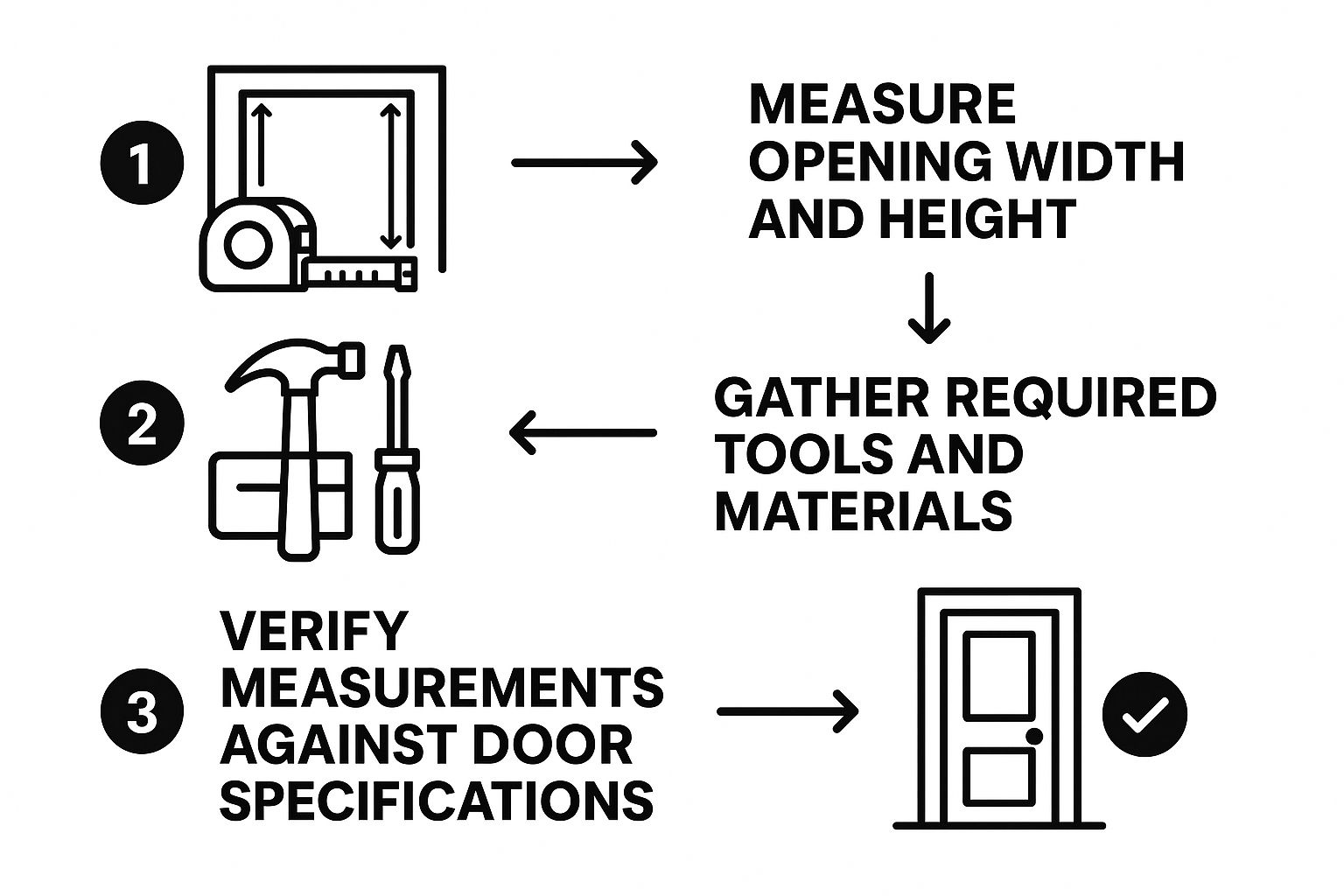
As the visual flow shows, checking your door’s specs against the opening’s measurements is the final checkpoint before you start the installation itself.
Securing the Frame and Track
With the frame held perfectly in position by the packers, you can now secure it. Start by drilling pilot holes through the frame and into the wall structure, right where you placed your packers. Always stick to the manufacturer’s guidelines on the size and spacing of the fixings – they’re there for a reason.
Before you drive the main fixings home, run a continuous bead of high-performance, low-modulus silicone sealant around the entire external perimeter of the frame. This creates your primary weatherproof barrier against our famously unpredictable British weather.
Now, drive your frame fixings in, starting with the sill and working your way up the jambs. After every couple of fixings, grab your spirit level and check for plumb and level again to make sure nothing has shifted. The frame should feel completely solid, with no movement at all.
Finally, it’s time to install the sliding track system according to your product’s specific instructions. This usually involves slotting it into the head and sill of the frame and securing it. Getting the track perfectly level is non-negotiable. Even a slight slope can cause the door to drift open or closed on its own, which is not only annoying but a potential safety hazard.
With the frame and track securely in place, you’re ready for the exciting part: hanging the door panels.
Hanging the Sliding Door Panels Safely
Alright, with the frame and track securely in place, you’ve hit the most satisfying part of the job. Hanging the door panels is where it all starts to come together and look like a proper sliding door. But this is no time to rush; these panels can be seriously heavy and awkward, so safety is paramount. I can’t stress this enough: get a second pair of hands to help you.
You always want to start with the outermost panel—that’s the one that will actually slide. This sequence is crucial because it gives you the room to get the second, fixed panel into position afterwards without a struggle. To lift it, have one person on each end. Lift with your legs, not your back, and do it together to avoid any nasty strains or, worse, dropping the panel.
Lifting and Engaging the Rollers
Getting the panel onto the track is a bit of a knack, but it’s straightforward once you get the feel for it. First, tilt the top of the door panel towards the frame. Your goal is to carefully guide the top rollers up and into the top track channel. You should feel them slot right in.
With the top rollers engaged, you can now gently swing the bottom of the panel inwards so it’s poised over the bottom track. Lower the panel slowly until you feel the bottom rollers connect. There’s usually a satisfying ‘clunk’ as the wheels settle into their groove. Give the panel a gentle nudge just to make sure it’s seated properly and moves smoothly.
A classic mistake I see all the time is not getting the rollers fully engaged. This leads to a wobbly, insecure door that just won’t run right. Take a moment to get your head down and visually check that both the top and bottom rollers are sitting perfectly on the track. This one simple check will save you a world of headaches later on.
Installing Essential Security Features
Now that the sliding panel is hanging, your very next job is to fit the safety and security hardware. Don’t think of these as optional extras; they’re absolutely vital for the door’s proper function and to stop it from being lifted off the track from the outside.
These components are what separate a shoddy installation from a professional one. In fact, the quality of sliding door hardware—from rollers to locks—is a huge deal in the industry. It’s a market niche valued at about £0.95 billion in 2024 and is expected to climb to around £1.4 billion by 2033. If you’re interested, you can explore the full research on sliding door hardware trends to see just how important these parts are.
The key pieces you’ll be fitting now are:
- Door Stops: These usually go in the top track. They prevent the panel from sliding too far and potentially derailing at the end of its run.
- Keepers: These are fixed to the frame and are part of the lock. They’re what the door latches into to keep it securely closed.
- Anti-Lift Blocks: Small but mighty, these little blocks are fitted into the track to prevent the door from being physically lifted upwards and removed. This is a critical security feature.
Follow your manufacturer’s instructions to get these fitted correctly. Once the sliding panel is fully secure, you can repeat the whole lifting process for the inner, fixed panel, securing it firmly into place as outlined in your guide.
Making Adjustments for a Perfect Glide
Right, with your door panels hung, you’re on the home straight. But don’t crack open the biscuits just yet. A proper sliding door installation isn’t finished until the door glides like it’s on ice. This is the fine-tuning stage, where a few small tweaks can make a massive difference to how your new door feels and performs every single day.
Even with a perfectly level frame, you’ll almost always need to make some minor adjustments. Honestly, these final touches are what separate a DIY job from one that looks and feels truly professional. It’s all about getting that smooth operation and preventing any unnecessary wear and tear on the rollers and track down the line.
The aim here is simple: get an even, consistent gap all around the panel and a silent, effortless slide. This is all done through the roller adjustment screws.
Using the Roller Adjustment Screws
If you look at the bottom edge of most sliding door panels, you’ll find small adjustment screws, often hidden under little plastic caps. These are your best friends for the next few minutes. They directly control the height of the rollers on each side of the panel, allowing you to raise or lower each corner independently.
Let’s say the bottom corner of the door, near the lock, is catching on the frame. To fix this, you just need to raise that side slightly. Grab an Allen key or screwdriver and give the adjustment screw a clockwise turn. The key here is to go slowly—make small, quarter-turn adjustments, and then test the door’s movement each time. You’ll be surprised how much difference a tiny turn can make.
On the flip side, if you notice a bigger gap at the top on one side, you might need to lower it by turning the screw anti-clockwise. Just keep making these tiny, incremental changes and checking the alignment until the panel sits perfectly square in the frame with a nice, even gap all around.
A really common frustration I hear about is a door scraping along the bottom track. Before you panic and think something is bent or broken, spend five minutes with an Allen key. Nine times out of ten, it’s just a roller height issue and a simple fix that completely transforms the feel of the door.
Aligning the Lock and Keepers
Once the door glides smoothly and sits squarely in its frame, the very last job is to make sure it locks properly. Slide the door closed and try the handle. If you have to yank the handle or push the door to get the lock to engage, the keep on the frame needs a little nudge.
The keep, or striker plate, is that metal part on the door jamb that the locking hooks grab onto. Thankfully, most modern keeps are adjustable. You’ll usually see a couple of screws holding it in place, which allow for a bit of wiggle room up, down, or side-to-side.
Slightly loosen these screws—just enough so you can move the keep—and adjust its position until the lock engages without any force or resistance. Test it a few times by locking and unlocking it. You’re looking for a satisfying, secure click, not a jarring crunch.
Troubleshooting Common Door Adjustments
Even with the best preparation, you can run into a few little niggles during the final adjustment phase. It happens to everyone. This table is a quick-reference guide I’ve put together from experience to help you diagnose and sort out the most common issues you might face with your new sliding door.
| Symptom | Likely Cause | Adjustment Solution |
|---|---|---|
| Door scrapes on the bottom track | The rollers are set too low. | Use the adjustment screws to raise the door panel slightly until it clears the track. |
| Door drifts open or closed | The main track is not perfectly level. | Re-check the track with a spirit level. You may need to use packers to correct the level. |
| A gap is visible on one side | The panel is not hanging square. | Adjust the roller height on one side to raise or lower that corner, squaring it up in the frame. |
| Lock is difficult to engage | The lock keep is misaligned. | Loosen the screws on the keep and adjust its position until the lock latches smoothly. |
With these tips, you should be able to get your door operating perfectly. Taking the time to get these final adjustments right ensures your door will be a pleasure to use for years to come.
Right, with your door panels hung and gliding just how they should be, we’re on the home straight. This final stage is all about getting that polished, professional look and, just as importantly, making sure the whole thing is sealed up tight against the British weather.
These finishing touches aren’t just for show. They’re your home’s last line of defence against draughts and moisture, protecting both your hard work and your property for years to come. This is where we turn a functional installation into a truly seamless part of your home.
First up, we need to cover the gap between the new door frame and the internal wall. This is a job for architrave, and getting the cuts spot-on is the key to a sharp finish.
Fitting Internal Trims and Architraves
For those really crisp, professional corners, you’ll need to make mitre cuts. This just means cutting the ends of your architrave at a 45-degree angle. When two pieces meet, they’ll form a perfect 90-degree corner. A mitre box and hand saw will do the job, but a mitre saw makes it quicker and more accurate.
- Measure Precisely: Measure the length you need for each side of the frame. You’ve heard it before, but the old carpenter’s rule is golden: measure twice, cut once.
- Cut with Care: Set your saw to 45 degrees and make your cut. Remember, the piece that meets it will need a corresponding 45-degree cut in the opposite direction.
- Dry Fit First: Before you even think about glue or nails, hold the cut pieces in place. Check the fit. If there’s a tiny gap, you can often gently sand the edge for a perfect join.
Once you’re happy, secure the trims. A good bead of wood adhesive on the back, followed by a few small finishing nails, will give you a solid, lasting hold.
Applying a Professional Sealant Bead
The final, and arguably most crucial, weatherproofing step is to apply a neat bead of silicone sealant around the frame, both outside and inside. Getting this right creates an impenetrable, waterproof barrier.
A common mistake I see is people applying way too much silicone and making a real mess of it. Use a good quality sealant gun and apply steady, even pressure to lay down a consistent, thin bead. Straight away, use a sealant finishing tool (or even a wet finger) to ‘tool’ the bead into a smooth, concave profile. This is what gives you that clean, professional look.
This final seal is more important than ever. With the big push towards energy efficiency in modern homes, every part of an installation has to perform. This drive is accelerating the use of advanced glazing and thermally broken frames in sliding doors. It’s no surprise the UK market for all doors, including sliders, is projected to grow from £2.41 billion in 2023 to a whopping £3.06 billion by 2029. Learn more about the UK door industry’s growth projections to see how quality installations like yours are part of this trend.
All that’s left is to fit the handles, any lock covers, and pop in the small drainage caps on the exterior sill. These little details complete the job, officially marking the end of your sliding door installation. Time to stand back and admire your work.
Got Questions About Your Sliding Door Installation?
Even with the best instructions in the world, it’s completely normal to hit a snag or have a question pop up when you’re fitting a new sliding door. Every home is a bit different, and that means every installation has its own quirks. Let’s tackle some of the most common issues I hear about, so you can get your project finished without a hitch.
A lot of the time, the questions I get are about how the door actually feels once it’s in. You’ve done all the hard work, but it just isn’t gliding like you imagined. Don’t worry, the fix is usually in the fine-tuning.
Can I Install a Sliding Door By Myself?
Honestly, while you might be able to handle some of the prep work alone, I would strongly discourage trying to fit a sliding door by yourself. It’s not a one-person job. Those glass panels, especially the double or triple-glazed ones, are seriously heavy and incredibly awkward to manoeuvre.
Trying to lift and hang one on your own is a recipe for a pulled muscle, or worse, a damaged door. For a safe and successful installation, you really need at least one other person to help with the heavy lifting. A second pair of hands makes all the difference when you’re getting the frame square and hanging the panels.
I’ve heard too many horror stories of someone trying to ‘walk’ a heavy panel into place on their own, only for it to slip and shatter. It’s a costly and dangerous mistake that’s easily avoided by roping in a friend, family member, or a local handyperson for an hour or two.
Why Is My New Door Drifting Open or Closed?
Ah, the phantom door! If your door won’t stay put and keeps sliding on its own, the culprit is almost always a track that isn’t perfectly level. Even a tiny incline, one you’d never spot by eye, is enough for gravity to take over and send the panel rolling.
To fix this, you’ll need to revisit the frame-setting stage. Get your spirit level out and check that bottom track again. If it’s off, you’ll likely have to take the panels out, loosen the frame fixings, and slide some extra packers under the sill to get it perfectly flat before tightening everything back up.
What’s the Best Way to Get a Professional Sealant Finish?
Getting that clean, tidy bead of silicone is a bit of an art, but it’s one you can definitely master. It all comes down to good prep and the right technique.
- Go Steady: Use a decent sealant gun; it gives you much better control. Apply firm, consistent pressure and try to lay the bead in one smooth motion without stopping and starting.
- Smooth it Out Straight Away: Don’t hang about, as silicone starts to form a skin pretty quickly. As soon as you’ve applied a section, run a sealant finishing tool or a wet fingertip along the bead to smooth it into a neat, concave shape. This also pushes the sealant firmly into the joint for a better seal.
- Clean Up as You Go: Keep a cloth and some white spirit nearby to wipe up any smudges immediately, before they have a chance to cure.
Taking your time on these finishing touches is what separates an okay job from a truly professional-looking installation.
At Doors Delivered, we believe the right door is the foundation of a great space. Whether you’re a homeowner tackling a DIY project or a trade professional managing a new build, we provide high-quality internal doors, pocket door systems, and accessories to bring your vision to life. Explore our curated range and find the perfect fit for your project at https://doorsdelivered8675.live-website.com.