
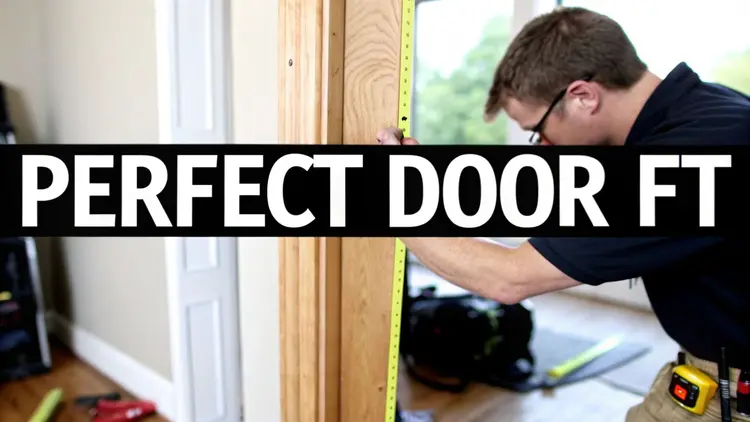
Before you can even think about fitting a new door, getting the measurements right is non-negotiable. It sounds simple, but I’ve seen countless projects go sideways because of a few millimetres’ difference. To get it right the first time, you just need a few basic tools and a clear understanding of what you’re actually measuring.
Your Essential Toolkit and Key Terminology

Let’s get our hands on the right gear. You don’t need a professional joiner’s entire workshop, just a handful of reliable items to guarantee your measurements are spot on.
Your Measurement Toolkit:
- A Quality Tape Measure: This is your best friend for this job. Make sure it’s a sturdy, steel one, ideally with a locking feature. It makes life so much easier when you’re working alone.
- A Spirit Level: Absolutely crucial. This little tool tells you if your frame is perfectly vertical (plumb) and horizontal (level). An out-of-square frame can cause a world of headaches with a new door.
- A Notepad and Pen: Don’t trust your memory. Seriously. Write down every single measurement as you take it. It’s a simple step that prevents very expensive mistakes.
Once you have your tools, it’s time to talk the talk. Knowing the lingo helps you measure the right parts of the frame. For a more visual breakdown, you can explore our guide to the components of various door frames.
Getting to Grips with Door Frame Terms
Getting your head around the terminology is half the battle won. The most common mix-up I see is people confusing the size of the old door with the dimensions of the structural opening. They are not the same thing!
Here’s a pro tip from years of experience: Never, ever measure the old door and assume that’s the size you need. Old doors are often trimmed and shaved down over the years to fit frames that have settled or warped. Always measure the frame itself to get the true, accurate dimensions.
Speaking of accuracy, let’s talk about a crucial concept, particularly here in the UK: the ‘clear opening width’. This isn’t just the width of the door panel. It’s the actual, usable space you can physically walk through when the door is open.
This detail is so important that the updated UK building regulations from 2022 now mandate a minimum clear opening width of 775mm for most new-build doorways to ensure proper accessibility. Getting this single measurement wrong can mean your project isn’t just inconvenient—it could fail a building inspection.
Getting an Accurate Door Frame Width Measurement
Nailing the correct width is often where a simple door replacement project can go wrong. A single measurement is rarely reliable, especially in older British homes where time and settlement can cause frames to shift ever so slightly, becoming out of square.
I’ve seen it countless times: a professional joiner will never measure just once. To get a true feel for your door frame’s width, you need to measure the internal opening from jamb to jamb at three distinct points. Think of it as a quick health check for your doorway.
This picture shows the first key step—measuring horizontally across the opening to get the width.
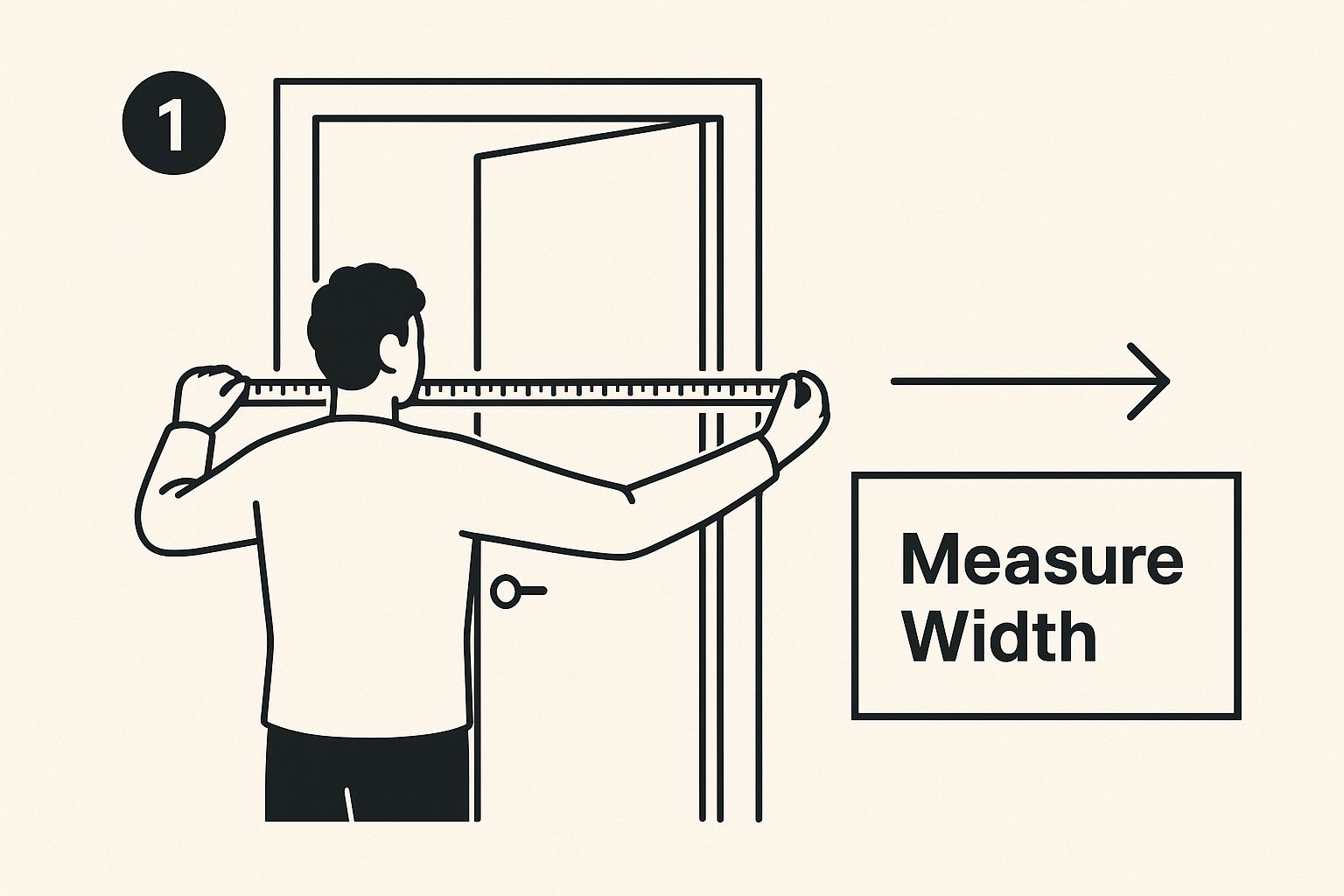
As you can see, keeping the tape measure perfectly level is vital for a true reading. Taking a few measurements like this ensures you account for any little quirks or inconsistencies in the frame.
The Three-Point Width Check
To do this properly, grab your tape measure and record the width at these three locations:
- Top: Measure across the very top of the opening, just underneath the head jamb.
- Middle: Take a measurement across the horizontal centre of the frame.
- Bottom: Measure across the bottom, right above the floor or threshold.
Jot down all three numbers. Don’t be shocked if they vary by a few millimetres; this is completely normal. For instance, you might end up with 764mm at the top, 762mm in the middle, and 763mm at the bottom.
So, which one do you use when buying your new door? The answer is simple, but absolutely critical.
Always use the smallest of the three width measurements. This is your golden number. Ordering a door based on the narrowest point guarantees it will fit into the opening without binding. It’s far easier to trim a door down than it is to fix a frame that’s too tight.
In our example, you would base your purchase on the 762mm reading. This simple step prevents the immense frustration of wrestling with a door that’s too wide to even close. It’s a fundamental rule that saves both time and money, ensuring your project gets off to the right start.
Getting the Height and Jamb Depth Spot On
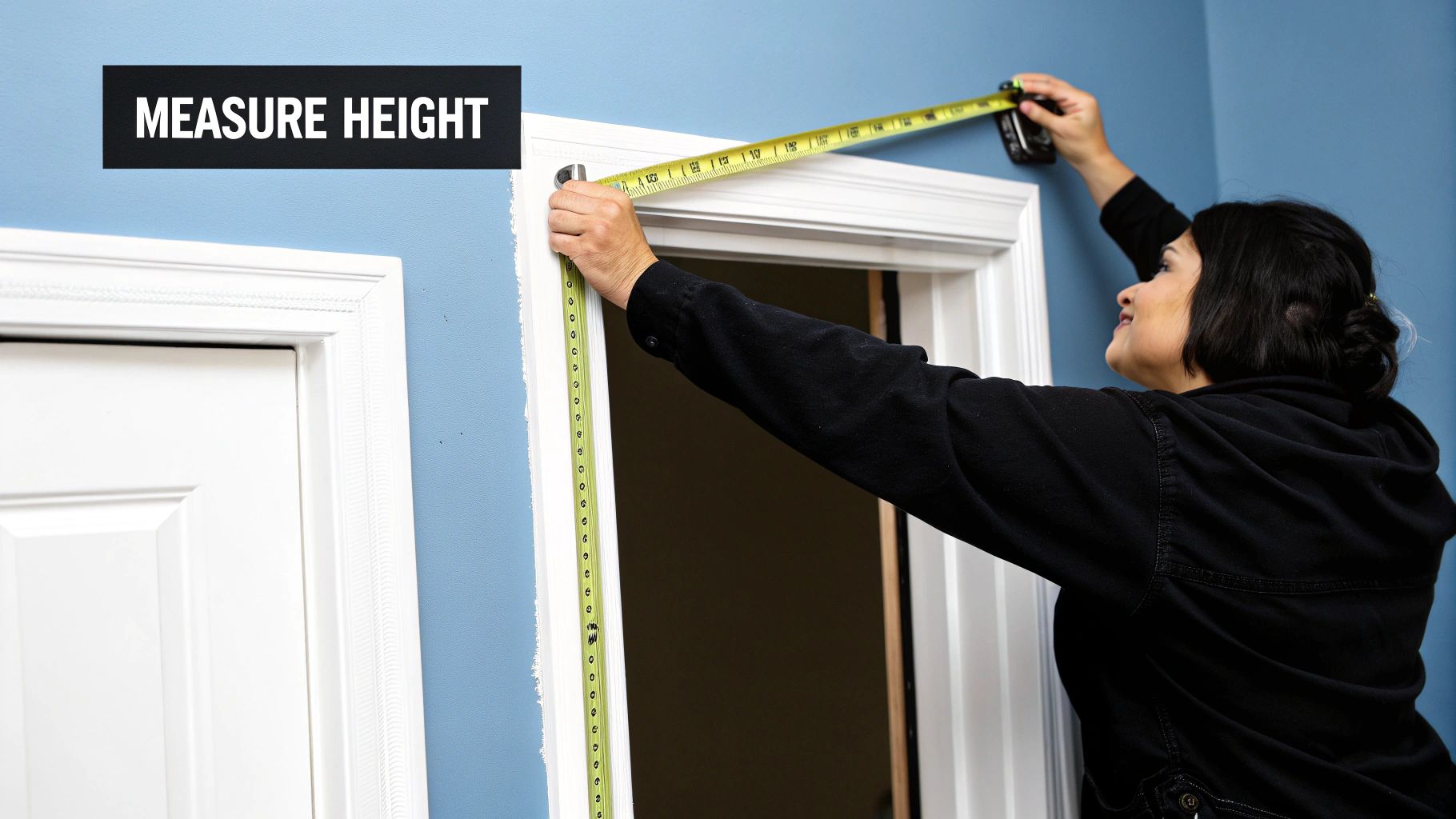
With the width sorted, let’s talk about height and jamb depth. I’ve seen it countless times – a perfectly good door ruined because these two measurements were glossed over. They’re just as crucial for getting that professional finish where the door hangs beautifully and operates without a hitch.
Much like measuring the width, you’ll need to take a couple of readings. Grab your tape and measure the internal height from the finished floor right up to the underside of the top jamb. Take one measurement on the left side and another on the right, noting both down. Again, the golden rule is to always use the smallest of the two height measurements for your order.
Why Your Flooring is So Important
One of the biggest mistakes I see people make is completely forgetting about the flooring. Are you planning on laying down some thick new carpet with plush underlay? Or maybe some sleek laminate?
You absolutely must measure from the final finished floor level. If you measure from the subfloor now and add 15mm of flooring later, you’ll end up with a door that scrapes and binds every time you open it. Factoring this in from the start saves you from having a door that either jams on the floor or leaves a massive, draughty gap underneath.
A good rule of thumb is to allow a gap of about 5-10mm between the bottom of the door and the finished floor. This gives enough clearance for most carpets and rugs without creating an excessive void.
Nailing the Jamb Depth
Now for a detail that often gets overlooked but makes all the difference: the jamb depth. Put simply, this is just the thickness of your wall, including the plasterboard and any plaster skim coat.
To get this measurement, place your tape measure on the edge of the frame and measure from its front face to its back face. Getting this right ensures your new door frame will sit perfectly flush with your wall, which in turn allows the architraves to be fitted neatly for a clean, professional look. An incorrect jamb depth is a real headache and creates an untidy finish that’s difficult to disguise.
From a practical standpoint, it helps to know the UK standards. Door heights are often 1981mm (that’s 6’6″) in England and Wales, but in Scotland, you’ll find they often go for taller 2040mm (6’8″) doorways. For a deeper dive into these regional differences, you can find some great information on standard door sizes on jbkind.com.
Decoding Standard UK Door Sizes
Knowing the standard door sizes used across the UK can be a real game-changer for your project. Think of it as learning a bit of the local language before you travel; it gives you the confidence to speak with suppliers, knowing exactly what you’re asking for. More importantly, it helps you sidestep the extra cost and long lead times that come with a bespoke, custom-made door.
Manufacturers work to a system of modular sizing, which makes replacing doors much simpler once you get your head around it. These standards weren’t just picked out of a hat. They’ve evolved over decades to meet modern demands for things like better accessibility and energy conservation.
Common Internal and External Door Sizes
In England and Wales, you’ll find that most internal doors share a standard height, but the widths often vary. The dimensions you’ll most commonly encounter are:
- Height: The most frequent height is a consistent 1981mm (that’s 6 feet 6 inches in old money).
- Width: Common widths include 610mm, 686mm, 762mm, and 838mm.
- Thickness: Standard internal doors are usually 35mm or 40mm thick.
External doors are generally a bit bigger all around, mainly to make it easier to get furniture in and out and to beef up security. Over the years, UK door frame measurements have shifted with architectural trends and efforts to align with European standards. While the internal door height has been fixed at 1981mm for ages, external door frames have broadened to widths from 813mm to 914mm. If you’re curious about the history, you can find more on the evolution of doors on Wikipedia.
Here’s a pro tip from years of experience: while these standards are a brilliant guide, always trust your own tape measure. An older home might have what was once a standard opening, but houses settle and shift. A standard door might still need a bit of trimming for that perfect fit.
The whole point of these standards is to make the building process, from a new build to a simple home renovation, much more straightforward. Once you’re familiar with them, you can plan your project and budget far more effectively.
For instance, if you measure your frame and get a width of 765mm, you’ll immediately know that a standard 762mm door is your best bet. That leaves you with a small, essential gap for the door to operate smoothly. This bit of knowledge turns measuring a door frame from a hopeful guess into a calculated, confident step, paving the way for a much smoother installation.
Common Measurement Mistakes to Avoid
Even with all the right gear and a clear plan, it’s the little mistakes that can cause the biggest headaches. I’ve seen it happen time and time again. Let’s walk through some of the most common pitfalls so you can get your measurements right on the first go, saving yourself a lot of time and money in the process.
One of the easiest slip-ups is simply misreading the tape measure. It sounds obvious, but when you’re crouched down or measuring at an awkward angle, it’s surprisingly easy to get it wrong. Always make sure your tape is perfectly straight and that you’re looking directly at the markings. This helps you avoid parallax error, a sneaky little optical illusion that can easily throw your measurement off by several crucial millimetres.
Another classic mistake is to take multiple measurements and then order a door based on the largest one. You have to fight that instinct. The golden rule is to always use the smallest measurement you get. This ensures the door will fit through the narrowest point of the frame. Trust me, it’s far easier to trim a door down slightly than it is to start messing with a frame that’s too tight.
Forgetting the Details
Beyond getting the basic width and height right, a few other details can easily trip you up. It’s absolutely vital to check that your frame is both plumb (that’s perfectly vertical) and square.
- Forgetting about new flooring: If you’re planning on laying down a thick new carpet or some laminate flooring, you have to measure from where the finished floor level will be, not the subfloor you see now. If you don’t, you’ll end up with a door that scrapes and jams every time you open it.
- Ignoring frame squareness: Grab a builder’s square and pop it into the corners of the frame. If you don’t have a perfect 90-degree angle, you’ll need to account for that when you fit the door to avoid ending up with uneven gaps around the edges.
- Confusing rough opening with door size: The measurements you’re taking are for the opening in the frame. The actual door you order will need to be slightly smaller to give it enough clearance to swing open and closed without catching.
The old saying “measure twice, cut once” exists for a good reason. Honestly, I’d even suggest measuring three times just to be absolutely certain. A few extra minutes with the tape measure now is far better than a costly ordering mistake later.
Finally, don’t forget that your choice of hardware will also affect the final fit and finish. Making sure you have all the right components, from the hinges down to the handles, is a key part of the process. You can see a great selection of door handles and knobs to get a feel for what’s out there.
Frequently Asked Questions About Measuring Doors
Learning how to measure a door frame raises a handful of specific queries. Here are straightforward solutions to the most common ones, so you can finalise your measurements with confidence.
Handling Non-Standard Sizes And Old Doors
If your frame falls between standard sizes—a situation I’ve come across in many older UK homes—here’s my go-to advice:
- Select the next standard size up. It’s far simpler to remove a few millimetres from a larger door than to build one up.
- Solid wood or solid core doors cope well with trimming.
- Steer clear of hollow core doors when significant resizing is needed: their edges lack solid material.
When it comes to measuring before you remove the old door:
- Don’t take the old door off its hinges just yet.
- Measure the frame’s internal space—from jamb to jamb for width, and from the head down to the finished floor for height.
- Doors can be hidden underneath layers of trimming—so relying on the door itself usually leads to error.
Key Takeaway: Leave a 2-3mm gap around a new door. It accounts for fresh paint layers and natural wood movement, preventing binding and sticking in use.
Measuring External Door Frames
At first glance, measuring an external frame follows the same width, height, and jamb-depth routine. However, you also need to factor in the threshold level and weather seals.
You’ll often find that the jamb depth is greater to suit thicker exterior walls. For a closer look at these elements, refer to the typical structure of a basic door lining.
At Doors Delivered, we provide the high-quality internal doors and systems to bring your project to life. https://doorsdelivered8675.live-website.com