
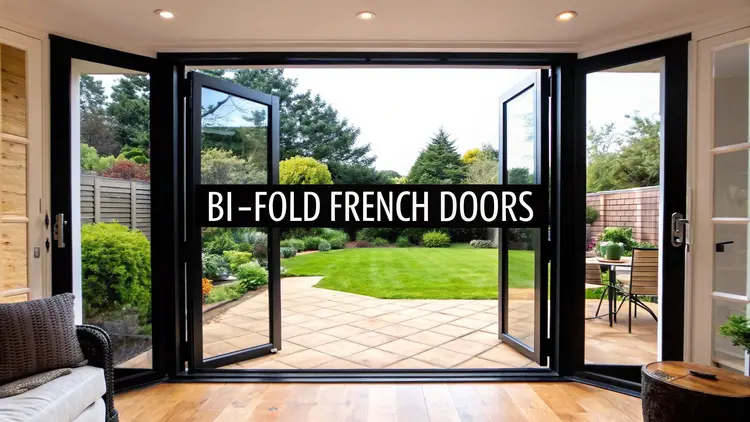
When you think of French doors, you probably picture classic, elegant glass panes. And when you think of bi-fold doors, you imagine a wide, seamless opening to your garden. What if you could have both?
A bi fold french door does exactly that. It masterfully blends the timeless, multi-paned charm of traditional French doors with the clever, space-saving concertina fold of a modern bi-fold. It’s genuinely the best of both worlds—classic style meets contemporary living. This hybrid design is completely changing how we think about our homes, creating huge, light-filled spaces without sacrificing an ounce of character.
The Ultimate Guide to Bi Fold French Doors
Picture this: on a warm summer day, you slide and fold away the entire wall between your living room and your garden. Suddenly, it’s one huge, flowing space, absolutely perfect for barbecues and family get-togethers. That’s the magic of a bi-fold French door.
Unlike standard French doors that swing in or out, taking up valuable patio or room space, these doors fold back on themselves. They stack neatly and compactly to one side, leaving you with a completely clear, unobstructed view. They’re more than just a door; they’re a genuine lifestyle upgrade.
By taking the beautiful look of French doors—with their distinctive multiple glass panes, often called ‘lites’—and pairing it with the smart mechanics of a bi-fold system, you get a real architectural showstopper. It’s a design choice that floods your home with natural light, makes your garden feel like a part of the room, and creates the brilliant illusion of a much bigger, more open living area.
Growing Demand in UK Homes
It’s no secret that this style of door has exploded in popularity across the UK. As a door specialist, I’ve seen first-hand how homeowners are desperate to connect their indoor living areas with their gardens and patios. The bi-fold concept delivers this connection flawlessly. This isn’t just a feeling; the numbers back it up.
The demand for bi-fold doors, in general, has seen a massive surge. Google searches jumped from around 70,000 per month in 2014 to over 108,000 per month by 2015. That’s a 54% increase in a single year! This incredible spike shows just how quickly homeowners have realised these doors are a must-have for a stylish, modern home. You can explore more data on this trend and see its impact on the home improvement market.
A bi fold french door isn’t just a purchase; it’s an investment in how you experience your home. It fundamentally changes the relationship between your interior and exterior, turning a simple wall into a gateway for light, air, and open-plan living.
This winning combination of features makes them a fantastic choice for almost any property, from brand-new contemporary builds to classic period renovations. They offer a practical solution for everyday life while adding serious aesthetic and financial value to your home.
Let’s quickly break down the core benefits.
Bi Fold French Door Key Features at a Glance
Here’s a simple table summarising what makes these doors such a compelling choice for homeowners.
| Feature | Benefit |
|---|---|
| Full Wall Opening | Creates a seamless transition between your home and garden, ideal for entertaining. |
| Classic French Styling | Offers timeless elegance with multi-pane glass designs that add character. |
| Enhanced Natural Light | The large glass surfaces allow sunlight to flood your interior spaces. |
| Space-Saving Design | Panels fold and stack neatly, requiring minimal space compared to swing doors. |
As you can see, they tick a lot of boxes, offering a unique blend of style, function, and modern convenience that’s hard to beat.
How Do Bi-Fold French Doors Actually Work?
The real magic behind a bi-fold French door is its surprisingly simple, elegant engineering. If you’ve ever played an accordion, you’re already halfway there. A series of individual door panels are hinged together, allowing the whole set to fold up and glide along a track in a smooth concertina motion. It’s this clever design that lets an entire wall of glass seemingly vanish, creating that incredible seamless link to your garden or patio.
To really get to grips with it, it helps to understand the core parts that work together so perfectly. Every bi-fold system, no matter the size or material, is built on three essential elements.
The Key Components
A bi-fold French door isn’t just glass and frames; it’s a precisely engineered system designed for fluid movement. Here’s a quick look at the parts that make it all happen:
- Panels: These are the individual door leaves that create the full set. Each one is hinged to its neighbour, forming the chain that folds so neatly. You can customise the number of panels to perfectly fit the width of your opening.
- Tracks: These are the channels fitted at the top and/or bottom of the door frame. The panels are connected to these tracks with rollers or guides, which is what ensures the doors slide smoothly and stay perfectly aligned as they open and close.
- Hardware: This covers everything from the hinges that connect the panels and the rollers that run in the tracks, to the handles and locking mechanisms. I can’t stress this enough: high-quality hardware is crucial for a door that operates effortlessly and remains secure for years to come.
This image really helps to visualise how these doors can completely open up a space, creating an effortless flow between inside and out.
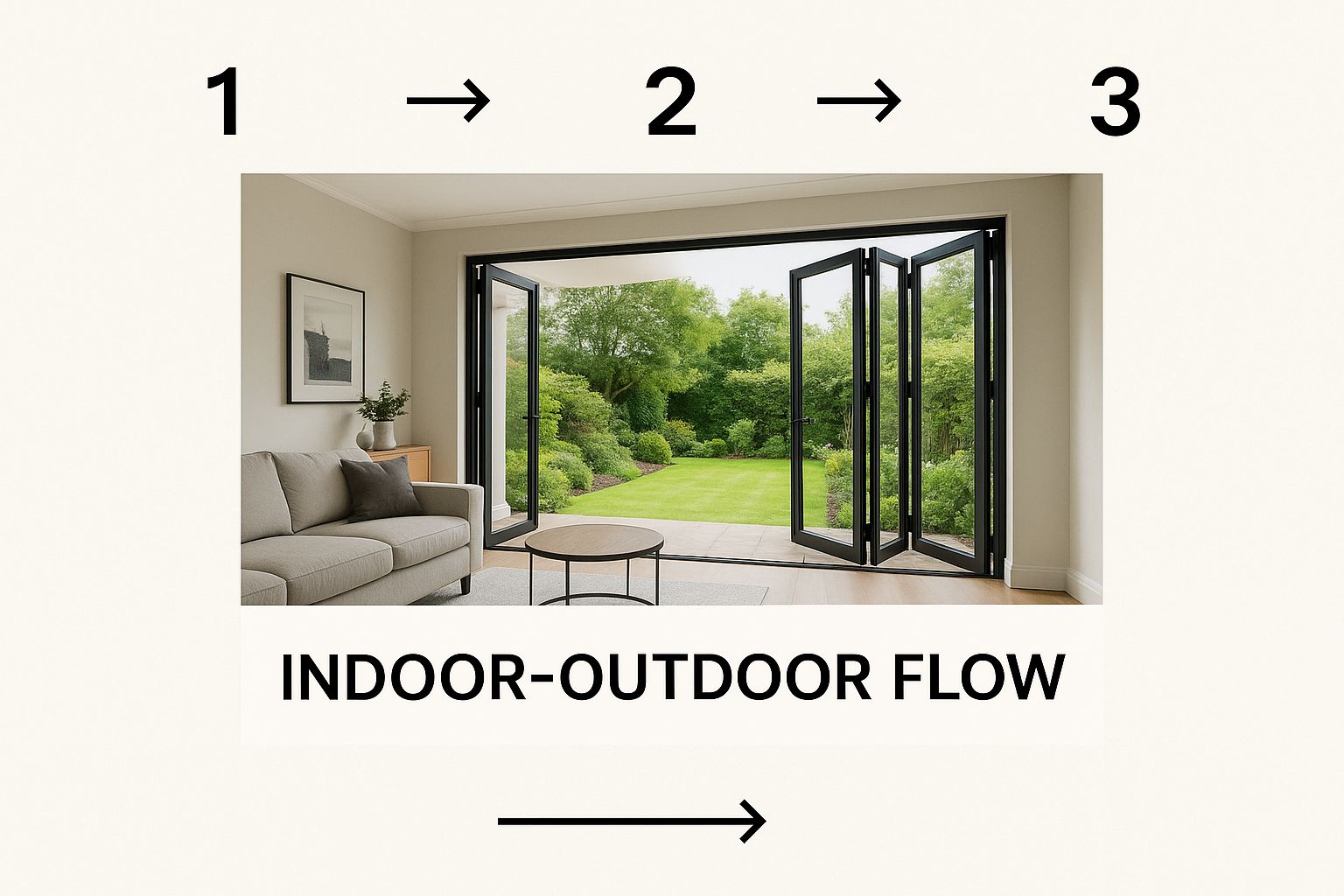
As you can see, the boundary between the living area and the garden is completely erased when the doors are fully open. This is what we mean by ‘indoor-outdoor flow’.
Top-Hung vs. Bottom-Rolling Systems
When you start looking into bi-fold French doors, you’ll hear two terms come up again and again: top-hung and bottom-rolling. The difference is all about where the weight of the doors is supported, and it’s an important distinction.
A top-hung system is the most common and, in my experience, often the preferred choice. Here, all the weight of the door panels hangs from rollers running in the top track, with a guide at the bottom simply keeping everything in line. This makes for an incredibly smooth and light operation, as the doors feel like they’re just gliding along. The one catch? It requires a strong lintel or structural beam above the opening to safely carry the entire load.
A bottom-rolling system, on the other hand, supports the weight on the bottom track. This is an excellent problem-solver for renovations where the overhead structure might not be strong enough for a top-hung system without significant (and costly) reinforcement.
While bottom-rolling doors are a fantastic solution in the right setting, it’s vital to keep that bottom track meticulously clean. Any dirt, grit, or small stones can get in the way of the rollers and make the doors stiff or difficult to operate smoothly.
The Practical Genius of a Traffic Door
One of the most useful features you can get with a bi-fold system is the traffic door. This is simply a single, conventional door at one end of the set that can be opened and closed on its own, just like a standard back door.
Picture this: it’s a chilly autumn day, and you just want to let the dog out quickly or nip into the garden for a moment. Instead of having to unlatch and fold back the entire wall of glass, you just use the traffic door. It gives you quick, convenient access for everyday use without touching the main system.
This feature adds a layer of immense practicality, making your bi-folds just as functional on a rainy Tuesday in November as they are on a glorious Saturday in July. It’s a small detail that makes a huge difference in day-to-day living, giving you the best of both worlds—the grand opening when you want it, and simple access whenever you need it.
Choosing the Best Material for Your Doors
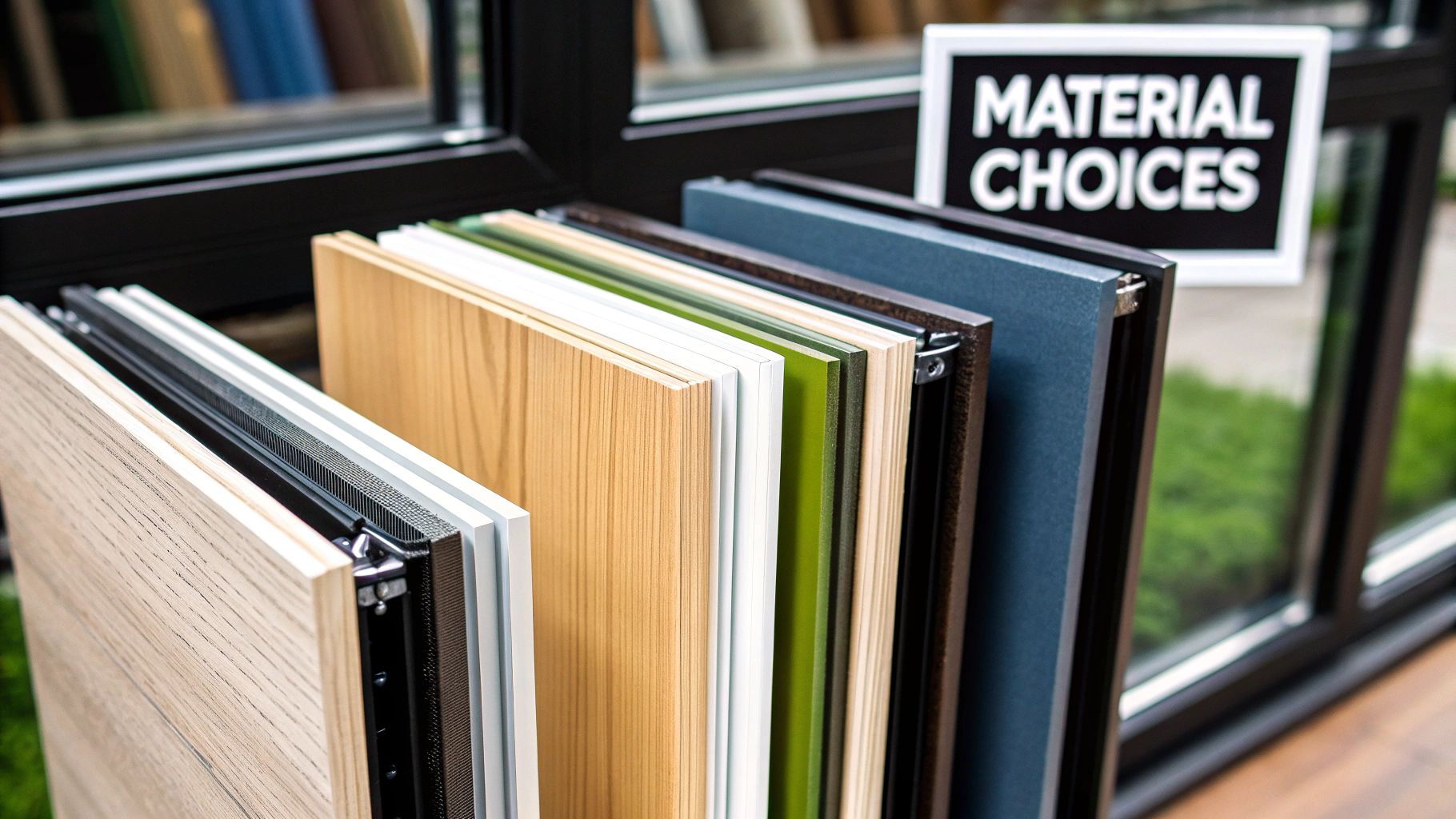
Picking the right material for your bi fold french door is probably the biggest decision you’ll make in this whole process. Think of it like choosing the engine for a car; it sets the tone for everything else. The material you go with will dictate how your doors look, how long they last, how warm they keep your home, and how much looking after they’ll need down the line.
Your choice will fundamentally shape how your doors perform for years to come. In the UK, the main players are sleek Aluminium, practical uPVC, and classic Timber. Each has its own personality, with a unique set of pros and cons. One will undoubtedly be a better fit for your home, budget, and lifestyle.
This isn’t a decision to rush. The material is a huge part of the overall cost, so it pays to get it right. Let’s break down each option so you know exactly what you’re choosing.
The Sleek Strength of Aluminium
Aluminium has shot to the top of the popularity charts for modern homes, and for very good reason. Its superpower is an incredible strength-to-weight ratio. This strength means the frames—what we call ‘sightlines’ in the trade—can be incredibly slim. And slimmer frames mean more glass.
The upshot? You get a stunning, almost unbroken view of your garden, which is what most of us are after when we invest in a bi fold french door. These slender profiles deliver a sharp, minimalist look that’s a perfect match for new builds and contemporary extensions.
Aluminium is also tough as old boots, standing up brilliantly to the UK’s notoriously damp weather. It won’t warp, rust, or corrode. Plus, the powder-coated finish gives you a resilient colour that doesn’t fade or demand a new coat of paint every few years.
Key Takeaway: If a massive, seamless view, a clean modern aesthetic, and next to no maintenance are at the top of your list, then aluminium is almost certainly your best bet. Nothing beats its slim frames for connecting your home to the outdoors.
The Practicality of uPVC
Unplasticised Polyvinyl Chloride—or uPVC as everyone knows it—is the undisputed champion of great value and easy living. If you’re working to a tighter budget, uPVC is a fantastic, cost-effective way to get that bi-fold look without the higher price tag of aluminium or timber.
Beyond the attractive price, the biggest draw for uPVC is how easy it is to look after. A quick wipe with a soapy cloth is all it takes to keep it looking brand new. It’s also a great insulator, thanks to multi-chambered profiles that are designed to trap heat and keep your home cosy.
Of course, there’s a trade-off, and that comes down to looks and strength. To get the necessary structural support, uPVC frames have to be thicker and chunkier than their aluminium counterparts. That means more frame and less glass. While modern uPVC comes in more colours than it used to, it just doesn’t have that same premium feel as the other options.
The Timeless Charm of Timber
For anyone dreaming of traditional beauty and natural warmth, nothing quite compares to timber. Wood has a classic, high-end feel that can be tailored to suit any home, whether it’s a rustic cottage or a grand period property. As a natural material, it’s also a fantastic insulator, making it a top performer for thermal efficiency.
Timber is also the most customisable option by a country mile. You can paint or stain it in any colour under the sun. This means you can get a perfect match for your home’s existing style or even change your mind and switch up the look a few years down the road.
This natural beauty does, however, come with a bit of homework. To protect it from the British weather and stop it from warping or rotting, a timber bi fold french door needs to be re-stained or repainted every few years. For some, that’s a deal-breaker. For others, it’s a small price to pay for the authentic character that only real wood can bring.
The UK bifold doors market is a big deal, and it’s getting bigger. It’s estimated to pull in £421.6 million in 2024 and is expected to hit £601.9 million by 2030. What’s really interesting is that timber is still the top dog, holding a 43.98% revenue share in 2024. But keep an eye on aluminium; it’s the fastest-growing material, which shows just how popular its modern appeal is becoming. You can explore the full UK bifold doors market analysis to see these trends for yourself.
Material Comparison at a Glance
Choosing between these three excellent materials can be tricky. To make it a little easier, I’ve put together a simple table that lays out the pros and cons of each, helping you see which one aligns best with what you want for your home.
Material Comparison for Bi Fold French Doors
| Material | Pros | Cons | Best For |
|---|---|---|---|
| Aluminium | Very slim frames, modern look, highly durable, low maintenance, wide range of colours. | Higher initial cost, less traditional appearance. | Modern homes and homeowners who want to maximise their view. |
| uPVC | Most affordable option, excellent thermal insulation, virtually no maintenance. | Thicker, bulkier frames, can look less premium, limited colour longevity. | Budget-conscious projects and those prioritising low maintenance over aesthetics. |
| Timber | Beautiful natural aesthetic, excellent insulator, can be painted any colour. | Highest maintenance needs, susceptible to weather if not maintained, can be expensive. | Period properties and homes where traditional character is the top priority. |
Ultimately, there’s no single “best” material—only the one that’s best for you. By weighing up the aesthetics, performance, maintenance, and cost, you can confidently pick the perfect foundation for your new bi fold french door.
Understanding the Performance and Security Benefits
While a beautiful bi-fold French door is a stunning style statement, its real value goes much deeper. The best systems are engineered to make your home warmer, quieter, and more secure, giving you total peace of mind. After all, when you’re investing in a large wall of glass, you need to know it can handle everything modern life—and the unpredictable UK weather—can throw at it.
It’s completely normal to worry about heat loss with such a large glazed feature. But you might be surprised to learn that modern bi-folds are incredibly energy-efficient, often performing far better than older, draughty patio doors. This isn’t just about comfort; it’s about keeping those energy bills down.
Let’s get into the specifics of what makes these doors a solid, high-performance choice for your home.
Keeping Your Home Warm and Your Bills Low
When you start looking at doors, you’ll come across the term U-value. It’s essentially a score for heat loss—the lower the number, the better the door is at keeping the warmth right where you want it: inside your home. UK Building Regulations have minimum standards, so make sure any door you consider meets or exceeds them.
This impressive insulation doesn’t happen by accident. It’s the result of a few clever design features working together:
- Advanced Glazing: Standard double glazing is good, but triple glazing takes thermal performance to the next level. The gap between the panes is filled with an inert gas like Argon, which acts as a fantastic insulator and dramatically slows down heat transfer.
- Thermal Breaks: This is a non-negotiable for aluminium frames. A thermal break is a strip of less conductive material built into the frame itself. It creates a barrier that stops the cold from travelling from the outside metal to the inside, preventing that chilly feeling you get from older metal frames.
- Weather Seals: High-quality compression seals and gaskets run around the entire perimeter of the frame. When you close the door, they form a completely airtight seal, killing draughts and stopping precious heat from escaping.
By bringing these elements together, a quality bi-fold French door can transform how comfortable your home feels, especially in winter, and help you cut back on how much you rely on your heating.
Security Features That Protect Your Home
A huge wall of glass might look inviting to you, but it can look like a weak spot to a would-be intruder. The good news is that reputable bi-fold door systems are designed from the ground up to be incredibly secure.
The most important thing to look for is PAS 24 certification. This is a critical security standard that confirms the entire door system—not just the lock—has been put through its paces and tested against common break-in methods.
Here are the key security features you should be checking for:
- Multi-Point Locking Systems: Forget a single lock and key. These systems bolt the door panels into the frame at several points along the track when you turn the key. This makes it incredibly tough for anyone to pry the door open.
- Internally Beaded Glazing: This is a simple but brilliant security detail. It means the glass panes are held in place by beading on the inside of your home, making it impossible for someone to pop the glass out from the outside to get in.
- High-Security Cylinders: The lock cylinder itself needs to be tough. Look for anti-snap, anti-drill, and anti-pick cylinders, which are designed to withstand the most common techniques used by burglars.
When all these features are combined and the doors are installed by a professional, you get a formidable barrier that ensures your stunning new entrance is as secure as it is beautiful.
What to Know About Installation and Planning
While it’s easy to get swept up in the dream of a wide-open living space, it’s important to remember that fitting a bi-fold French door is a serious construction project. This is definitely not a weekend DIY job; it’s a task that calls for seasoned professionals. Getting the installation right is absolutely critical for the long-term performance, security, and smooth operation of your investment.
A flawless fit begins long before the doors even arrive on site. The very first, and most crucial, step is a structural survey. Your installer will need to properly assess the existing wall to ensure it can safely handle the considerable weight of the new door system and the wide opening you’re about to create.
This isn’t just a quick glance. It’s a professional evaluation to figure out if the wall is load-bearing and, if so, what kind of structural support is needed to keep everything safe and secure.
The Importance of Structural Support
If you’re replacing a smaller window or door, or cutting a brand-new opening, it’s almost certain you’ll need a new lintel. Think of a lintel as a horizontal beam—usually steel or concrete—that sits above the opening and carries the immense weight of the wall above it. Without the correct lintel, you risk serious structural problems down the line, from ugly cracks in the plaster to major wall failure.
Your installer or a structural engineer will calculate the precise size and specification needed for the lintel, ensuring your home remains safe and sound for years to come.
Key Takeaway: Whatever you do, never skip the structural survey. It’s a vital safety check that protects your property and guarantees the integrity of your new bi-fold French door installation. Trying to cut corners here can lead to disastrous and eye-wateringly expensive repairs.
You’ll also need to get familiar with local rules. While many patio door replacements fall under ‘Permitted Development’ rights, creating a large new opening might mean a chat with your local council about Building Regulations or even planning permission. A reputable installer will be your best guide through this process.
Finding the Right Installer
Finding a qualified and experienced installer is the single most important decision you’ll make in this entire project. The UK doors market is huge, and patio doors—especially bi-folds—are a massive part of it. Trends are pushing towards better energy efficiency and homeowners wanting more light and style, which makes professional installation more important than ever. You can discover more insights about the UK patio door market trends from Sheerwater Glass.
A great installer ensures your door glides flawlessly and is perfectly weathertight. Here’s what to look for when vetting potential fitters:
- Experience with Bi-Folds: Don’t be shy. Ask to see a portfolio of their previous bi-fold door installations.
- Accreditations: Look for certifications from schemes like FENSA or CERTASS. These show they are competent and work to recognised industry standards.
- Comprehensive Quotes: A good quote will break down every part of the job, from removing the old door to the structural work and making good afterwards. No hidden surprises.
- Insurance: Make sure they have public liability insurance. This covers any accidental damage to your property during the work.
By planning carefully and choosing a skilled professional, you can ensure your beautiful new bi-fold French door is a source of joy for many years to come.
Of course. Here is the rewritten section, crafted to sound like an experienced human expert and match the provided examples.
Common Questions About Bi-Fold French Doors
Deciding on a major home improvement like bi-fold French doors is a big step, and it’s completely natural to have a few questions. From my experience, I know homeowners are thinking about everything from the day-to-day practicalities to how it impacts their home’s look and security.
To help you feel totally confident in your choice, I’ve put together some straightforward answers to the queries I hear most often. We’ll get into the important details on cost, security, and real-world use to clear up any doubts.
Are Bi-Fold French Doors More Expensive Than Sliding Doors?
Yes, generally speaking, a bi-fold French door system does come with a higher price tag than a standard sliding patio door. The main reasons are the more intricate folding mechanism, the multiple individual panels, and the sophisticated hardware required to make sure everything runs smoothly and reliably. You can usually expect to pay 20% to 50% more for bi-folds than for a simple two-panel slider covering the same opening.
However, that price gap can shift quite a bit depending on a few key things. The material you choose is a huge factor—sleek aluminium is a more premium option compared to practical uPVC. Glazing also plays a big part; triple glazing will naturally cost more upfront than standard double glazing.
Despite the higher initial spend, many homeowners I’ve worked with find the investment is more than worth it. The sheer wow-factor, the ability to open up an entire wall without obstruction, and the significant value they add to a property often make the extra cost a no-brainer.
How Secure Are Bi-Fold French Doors?
This is one of the most critical questions, and the answer is reassuringly positive. Modern, high-quality bi-fold French doors are engineered with security at their core and are incredibly tough when specified and installed correctly. Forget any old ideas about flimsy patio doors; today’s systems are a serious deterrent to intruders.
The single most important feature to look for is certification to PAS 24. This is an official standard confirming the entire door set has been rigorously tested to stand up to common break-in methods.
A quality bi-fold system isn’t just about a strong lock; it’s a combination of security features working together. When professionally installed, a PAS 24 rated bi-fold door is one of the most secure patio door options you can choose for your home.
Here are the key security elements that create this robust defence:
- Multi-Point Locking Systems: These lock the door panels into the frame at several points along the height, making them extremely difficult to pry open.
- Internally Beaded Glazing: A simple but crucial detail. It means the glass can only be taken out from inside your home, blocking a common entry tactic.
- High-Security Cylinders: Modern lock cylinders are designed to resist picking, drilling, and “snapping”—all common methods used by burglars.
- Anti-Lift Blocks: These are fitted inside the track to stop anyone from being able to force the panels upwards and off their runners.
Do Bi-Fold Doors Take Up Much Space When Open?
It’s a very common and understandable worry, but the reality is that the design is remarkably space-efficient. When you open a bi-fold French door, the panels glide and stack neatly to one or both sides of the frame. This concertina-style fold means the stacked panels take up far less room than you might think.
The real advantage here is when you compare them to traditional French doors. Classic French doors need a wide, clear arc to swing open, either into your room or out onto your patio. This can seriously restrict where you place furniture, plant pots, or the barbecue.
Bi-folds completely solve this issue. The stacked panels typically only stick out a few hundred millimetres from the frame. This lets you furnish your home and garden right up close to the opening without anything getting in the way—a massive practical win, especially where every bit of patio or floor space matters.
What Maintenance Do Bi-Fold French Doors Require?
The good news is that keeping your bi-fold doors in top shape is surprisingly simple. The main tasks really just depend on the material you’ve chosen. For any type of bi-fold, the most important job is keeping the tracks clean.
Getting the vacuum out regularly with a nozzle attachment to clear any dirt, grit, or leaves from the bottom track is essential. This one simple step ensures the rollers can glide smoothly and stops debris from building up, which could make the doors stiff or hard to open over time.
Beyond keeping the tracks clear, the routine is pretty straightforward:
- For all materials: A few times a year, give the glass and frames a wipe-down with a soft cloth and some mild, soapy water. Steer clear of any harsh chemicals or abrasive cleaners.
- Aluminium and uPVC: These materials are incredibly low-maintenance. Other than the routine clean, they require practically no other upkeep.
- Timber: Wooden doors need a bit more TLC to keep them looking their best and protected from the British weather. Depending on their exposure, you might need to re-stain or repaint them every 5-7 years.
A light spray of a silicone-based lubricant on the hinges and other moving parts once a year is also a great habit to get into. It’ll keep everything operating as smoothly as the day it was installed.
At Doors Delivered, we believe that the right doors are the foundation of a great space. Explore our collection of premium internal doors and systems to find the perfect solution for your project. Visit us at Doors Delivered to see how quality craftsmanship can elevate your home.